
Amelia County Arrest to Court
The arrest-to-court path in Amelia County uses more than one record system. A booking record starts with custody: identity, intake time, arresting agency, charges, bond fields, and possible court or warrant numbers if PRJ displays them. A court record starts when a charge is filed or docketed in the proper Virginia court. The court record then tracks hearings, charge changes, bond orders, continuances, warrants, capias entries, plea, trial, dismissal, nolle prosequi, or conviction.
The official Amelia County courts page links readers to Virginia's Case Status and Information systems. The state case-status page says the Online Case Information System-Statewide Search provides adult criminal case information in juvenile and domestic relations district courts, criminal and traffic case information in general district courts, and select circuit court information. Circuit and general district searches can use name, case number, or hearing date where applicable.
The Amelia County courts page provides the local court links used after an Amelia County jail arrest.
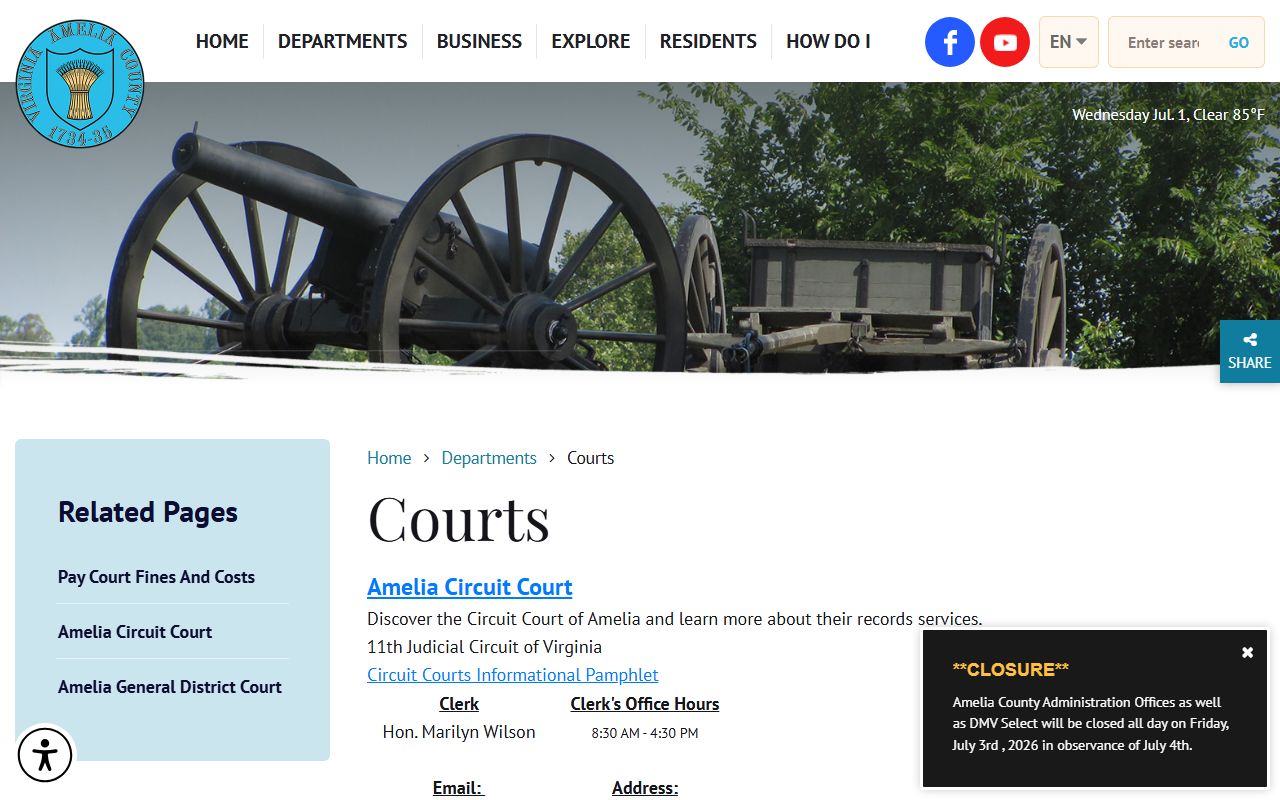
The local page is the bridge from regional jail custody facts to Virginia court case search tools.
Search Court Records After Arrest
Use the jail roster to collect identifiers before searching court records. A PRJ profile may show the person's name, booking date, arresting agency, charge description, court type, court date, warrant number, control number, or case number. Not all fields are guaranteed to be public. If the roster has a court date or case number, use it to narrow the Virginia court search.
- Confirm booking or custody through PRJ Offender Lookup or by calling PRJ.
- Write down the full name, booking date, arresting agency, charge, court type, warrant number, case number, and court date if shown.
- Open Virginia Case Status and Information or the OCIS statewide search.
- Search Amelia County court records by name first, then narrow by case number or hearing date when possible.
- Compare the jail charge to the court charge, because prosecutors and courts can amend, reduce, dismiss, or replace charges.
Amelia County Court Search Fields
The research captured the core search routes named by Virginia's court information pages. Court level matters. General District Court often handles misdemeanors, traffic, first appearances, and preliminary felony hearings. Circuit Court handles felony trials, indictments, appeals, and higher-level criminal matters. Juvenile and Domestic Relations District Court information has additional access limits, especially for juvenile records.
| Field Label | Type | Required | Options / Format Notes |
|---|---|---|---|
| Name | Text | One search path | State systems may support name search where applicable. |
| Case Number | Text | One search path | Best when the roster or clerk provides an exact number. |
| Locality | Dropdown | Required in locality searches | Choose Amelia County or the Amelia court level being searched. |
| Hearing Date | Date | Optional search path | Circuit and general district pages mention hearing-date search. |
| Court Level | Portal choice | Yes by workflow | OCIS statewide, circuit, general district, and JDR paths differ. |
The Virginia court case-status page explains the case search options used for court records after an arrest.
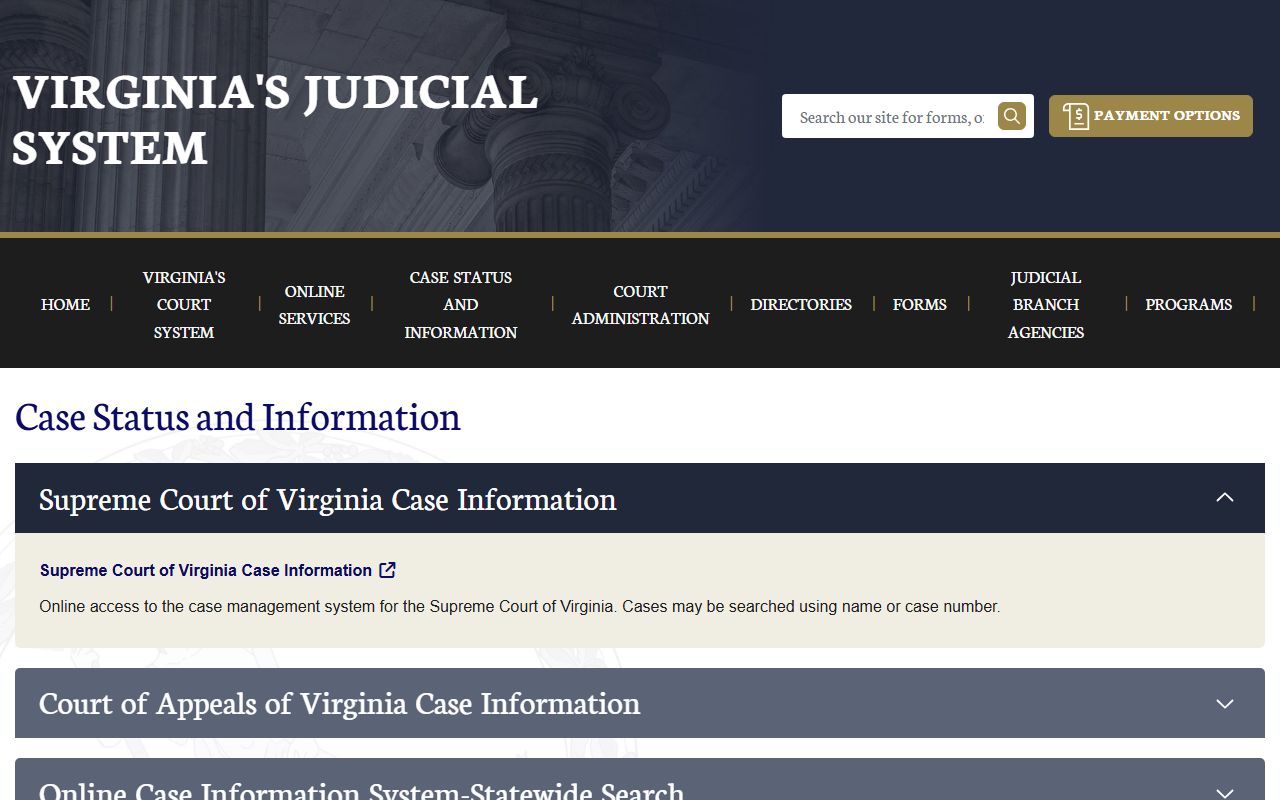
State court search is the better source for filed charge status, hearing dates, and disposition than a jail booking page.
Charge Versus Conviction
A charge is an accusation or filed offense. A conviction is a court outcome after a plea, finding, or verdict. Jail records can show arrest or booking charges before the Commonwealth's Attorney and court finish the charging path. That is why court records after a jail arrest should be checked before treating a roster entry as the final case result.
| Record term | Meaning | Where it appears |
|---|---|---|
| Arrest charge | Initial offense tied to arrest or booking | Jail roster, warrant, arrest paperwork |
| Filed court charge | Charge opened in a court case | Virginia court case system and clerk records |
| Amended or reduced charge | Charge changed by court or prosecution action | Court docket and orders |
| Dismissed or nolle prosequi | Charge ended without conviction at that time | Court disposition |
| Conviction | Guilty finding or accepted guilty plea | Court disposition and criminal-history channels |
Amelia County Charging Documents
Court records after an arrest may begin with different documents. The name of the document can signal the stage of the case. A complaint or warrant often begins a lower-court case. An information or indictment can move a felony case into Circuit Court. The exact document must be checked in the court file or case system because the jail roster is not the official court file.
| Document | Plain meaning | Typical use |
|---|---|---|
| Complaint or warrant | Written accusation or court-issued arrest authority | Initial criminal process and General District Court path |
| Information | Formal prosecutor-filed charging document | Some felony prosecutions when legally permitted |
| Indictment | Formal charge returned by a grand jury | Circuit Court felony case path |
Amelia County Court Contacts
Amelia Circuit Court is in the 11th Judicial Circuit of Virginia. The clerk is Hon. Marilyn Wilson. The court page lists clerk hours as 8:30 a.m. to 4:30 p.m., Circuit Court convening normally at 9:00 a.m., terms on the first Tuesday of February, April, June, August, October, and December at 10:00 a.m., criminal days on the first Thursday and third Friday each month at 9:00 a.m., and grand juries on the first day of term.
Amelia Circuit Court
P.O. Box 237, Courthouse Square
Amelia, VA 23002-0237
(804) 561-2128
Clerk: Hon. Marilyn Wilson
Commonwealth's Attorney
9127 Washington Street
Amelia, VA 23002
(804) 561-3302
Prosecution office for criminal cases
Commonwealth Attorney Case Role
Virginia uses the title Commonwealth's Attorney rather than District Attorney. Amelia County's official page identifies Lee R. Harrison as Commonwealth's Attorney. The office represents the people of Virginia in criminal prosecutions. The page says Commonwealth's Attorneys prosecute felonies, including the most serious crimes, and may prosecute Class 1, 2, and 3 misdemeanors at the office's discretion. This office does not run the jail roster, but it can affect which charges appear in court after a jail arrest.
The Amelia Commonwealth's Attorney page documents the prosecutorial role after an Amelia County arrest.
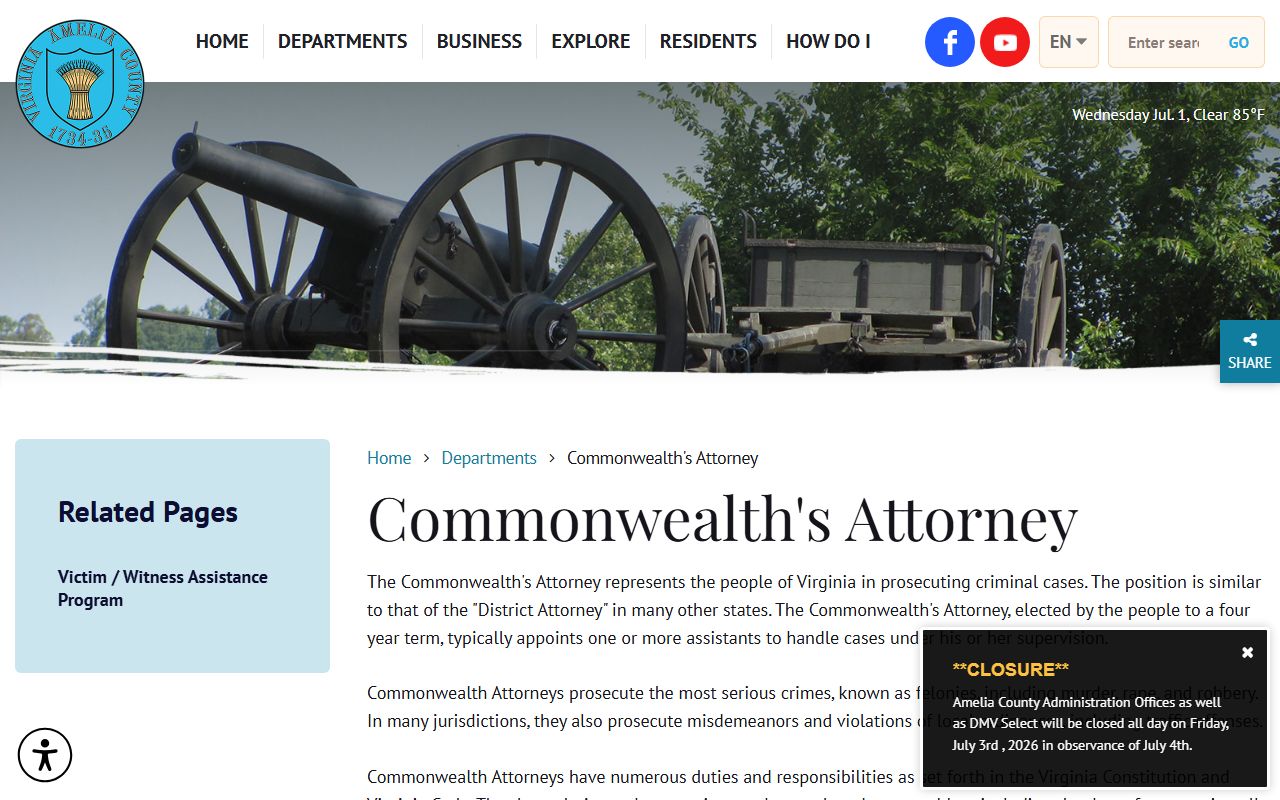
That office is relevant to filed charges, amendments, prosecutions, and victim-witness services, not to jail custody confirmation.
Bond Holds and Court Records
Virginia bail law defines bail as pretrial release from custody on terms set by a judicial officer. Bond is the written promise, secured or unsecured, that backs those terms. Section 19.2-120 says a person held pending trial or hearing is generally admitted to bail unless statutory risk findings support detention. A jail roster may show bond type or amount if PRJ enables those fields, but formal changes often come from court or magistrate action.
- Personal recognizance: release based on a promise to appear without secured money up front.
- Secured or cash bond: money or security must be posted before release.
- Surety bond: a licensed bondsman or approved surety posts bond.
- No-bond status: custody continues until a court or legal authority changes the hold.
- Detainer: another court, probation, federal, or immigration hold may prevent release.
Warrants Capias and Arrest
No official Amelia County sheriff active-warrant list was located in the county or sheriff pages reviewed. Court records can still show warrant, capias, failure-to-appear, and hearing activity tied to a criminal case. A warrant can produce a jail booking, but a search warrant does not mean the subject is in jail. A capias often relates to failure to appear or post-judgment arrest. A fugitive or probation violation warrant can also create a hold.
For a warrant question, use a cautious fallback chain: call the Amelia County Sheriff's Office for local warrant questions, search Virginia court systems for related case activity, and contact the issuing court or a Virginia attorney before trying to resolve an active warrant. Walking into a court or sheriff's office can result in arrest if a warrant is active.
Sealed and Expunged Records
Public access changes when a record is sealed, expunged, juvenile, or otherwise restricted. Virginia section 2.2-3706 says expunged and sealed records are prohibited releases unless dissemination is authorized by the sealing or expungement statutes and rules. Juvenile law-enforcement records are also protected under separate law. A public court search may therefore omit records that once had a jail booking connection.
| Status | What it means | Search effect |
|---|---|---|
| Public adult case | Accessible unless a specific law limits release | May appear in Virginia court search |
| Sealed record | Court access is restricted by order or statute | Public systems may hide or limit it |
| Expunged record | Legal relief removes public access to qualifying records | Agencies should not release it unless law allows |
| Juvenile record | Protected under juvenile confidentiality rules | Public access is narrower than adult cases |
FOIA and Clerk Fallbacks
If the court portal does not answer the question, contact the clerk for the relevant court. For sheriff or jail records, use the Amelia County FOIA page or PRJ records contacts. Virginia FOIA section 2.2-3704 requires reasonably specific requests and generally requires a public body to respond within five working days. Criminal-history dissemination under section 19.2-389 is different from a public jail roster or court docket, so do not treat a public search as a complete background check.
For the custody side of a case, use Amelia County inmate records. For booking photos, use the Amelia County jail mugshots page and the official FOIA channels described there.